Saturday, January 25, 2014
Five Hour Portrait Sketch
Thursday, May 27, 2010
The Nude Bares(sic) Repeating
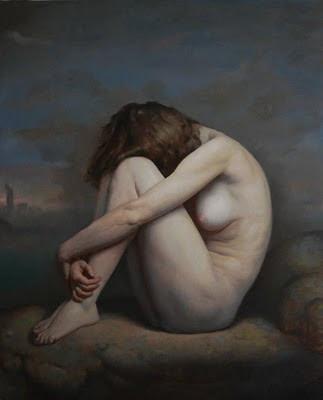
But the zeitgeist is shifting. My viewpoint on the changing climate was referenced in an article by arts journalist Pat Rogers about the return of the figure, along with that of photographer / video artist Jane Martin who beautifully dissolves the nude behind screens of mist and water.
So the figure is back and she is being led by the hand into the spotlight by young artists like Adam Miller. It's happening. But what is driving it? If we want to encourage the trend it would help to know.
Business As Usual for 35,000 Years

An easy answer to the question "why now?" would be that humans are simply back to the "business as usual" which started our 35,000 years ago with the Hohle Fels Venus statuettes (Photo by H. Jensen, Universität Tübingen). According to this mode of thinking, modernism will turn out to be a brief 80 year interruption caused by the ironic joke of Duchamp, whose pranks were a necessary breath of fresh air at the time but were taken a little too far for a little too long. After all, why should today's painters pay much heed to a fellow who didn't think very highly of "ocular" art in the first place, and would rather be playing chess?
Another easy answer is that there is no art historical conflict here worth discussing, because the distinction between abstraction and representation is an artificial one that has disappeared for all practical purposes. Realist painters have internalized and co-opted the critical language, processes, narrative and concepts of modernism since Eric Fischl and Vince Desiderio made their intellectual forays in the 1980s against the "painting is dead" crowd. I don't know very many realists who claim that their job is to be a visual journalist by faithfully coping nature, yet I often hear painters talk about interpreting their authentic visual experience through the language of abstract shapes and imposing a conceptual understanding of the subject matter, whether that concept entails psychological presence, narrative, or form itself.
Both of these attitudes have a case to make, but I suspect there is a deeper cultural shift at work. Young artists are experiencing global interconnectedness via the environmental movement and issues like global climate change. They are hyper-connected in their informational nakedness on the internet, and after 8 hours a day on Facebook and in the studio craving the desire for real human connection.
The economic climate may have been the point of inflection. Since the 2008 crisis, disenchantment with market-driven value systems has positioned realism as the "blue chip value stock" of art. Skillful execution invests an object with uniqueness, irreplacability, and therefore intrinsic value that is independent of market fluctuations.
To the ears of this young 21st century audience, Picasso's statements below have a different ring to them:
"Obviously, nature exists so we may rape it"
"I too believe that everything is unknown, that everything is an enemy!"
New York: First Avon Books Printing, October 1989.
It's an adolescent and meatheaded ring, to be specific. Yet not so long ago, such sentiments were seen as the testosterone-spiked fuel of a great creative engine. Our information age has exposed utterly forgotten 19th century sensations like Meissonier, the most commercially successful artist of a half-century now ignored and unmentioned in the textbooks, so we can plausibly imagine a time 50 years from now when Picasso becomes the Meissonier (or even the Bouguereau) of the 20th century.
Our sense of beauty is what makes us human, even more so than our logical reasoning which is so easily twisted to evil ends, or recruited into the service of our emotions, or used to justify our egotistical desires.
The project of aesthetics has failed to define universal criteria for beauty, and so thinking about Beauty is now considered to be a a dead-end endeavor. Even Tolstoy threw up his hands and criticized the notion of beauty reduces to "that which I find pleasing."

But Beauty is not merely a subjective feeling; it is intricately linked to the basic fabric of the universe, as any mathematician or physicist knows. In mathematics for example we are confronted with mysterious idea of "elegance", that the most aesthetically beautiful mathematical solution is almost always the correct one. Throughout the history mathematics, the beautiful solution which displayed characteristics of simplicity, harmony and proportion yet seemed to have no practical application has proven crucial in Physics 50 or 100 years later. Mathematical ideas like the Golden Ratio (left, image by Joel Holdsworth) demonstrate how our intuitive sense of beauty has a deep kinship with the fundamental laws of nature.
A beautiful object acts as a pointer to an underlying truth that expresses a harmony with the fundamental nature of reality. Beauty defies objective categorization because it is a material object pointing to the immaterial truth. The tangible acts as a compass needle pointing to the intangible. Rather than despair over the fact that Beauty defies definition in concrete terms, it is this fluid quality of Beauty that liberates the artist. It is the role of the artist to propose a definition of Beauty in the visual language of her particular life experience.
Post-modernism has left us at a dead end: if anything can be art, then art it is nothing. This vacuum has taken the notion of the avant garde down with it as well. Today's artists are presented with a blank slate, armed with a treasure trove of digital imagery from all of history, and freed from the conformist pressure of a self-appointed avant garde.
In this liberated art historical vacuum , the current zeitgeist of connectedness has brought us right back to business as usual for humans. Here we are, still looking at each other naked, compelled to do the least necessary yet most essential activity: making Art, the inspired exercise of a craft for the purpose of intentionally transmitting, through external indications, the thoughts and emotions which the artist has experienced.
Thursday, January 15, 2009
Chelsea Gets Back to the Future
The resurgence of figurative realism which has marked the past decade seems to have kicked into high gear with exhibits by artists such as David Jon Kassan who recently showed at Gallery Henoch in New york City's Chelsea art district. This is a really encouraging development: my memories of a Chelsea art crawl two years ago featured plastic garbage bags tacked to a gallery wall along with a pile of smashed up ping-pong balls on the floor. As is the custom in these parts, the garbage bags were accompanied by the obligatory essay. The arranger of crushed plastic had been hard at work re-contextualizing the viewer's perception of what art is, finding found objects and leaving the job of making the stuff that actually is art (or might be art if properly "contextualized") to less "discursive" folk.
A big relief it was then, in September of 2008, to see the likes of David Kassan's solid figures posed against graffiti- scarred concrete walls. Kassan's chunky, visceral build-up of paint in the lights points in the direction of Rembrandt's emotional heaviness. An obsessive attention to the topography of flesh lends gravitas to the subjects. The gritty urban backdrops echo the grooved textures of flesh and neatly marry abstraction and realism. The result is a figurative oeuvre that is contemporary to its bones, but stands confidently on the shoulders of past giants.
David Jon Kassan Web Site:
http://davidkassan.com/
Gallery Henoch:
http://www.galleryhenoch.com/
Wednesday, January 14, 2009
An Empire of Flatness
A question often posed to artists who paint the human figure from life:"Why don't you just take a photograph?"
The relationship between photography and painting has become a complicated and interesting one as Hyperrealists execute impressive technical feats through software-assisted "human laser-printer" activities worthy of an android. Digital imaging technology provides an unlimited range of settings for the figure, liberating artists from the confines of what is possible in studio setups.
Yet, in spite of all the technology that money can buy for art star Photorealists like Damien Loeb, figure painting based on photography often reads as emotionally shallow, lacking the organic harmony and psychological center of interest necessary for that elusive feeling of "life energy" in an image. Photo-based figure painting is often executed in a manner that is airbrushy, uniformly resolved, undifferentiated, flat.
Contemporary Photorealists employ a process somewhere in between photography, digital graphic design and painting. The totality of the visual experience has been converted into an abstraction by the machine which the artist then re-interprets and enhances, working in a place several steps removed from the orginal visual experience.
The prevalence of photo-based figurative painting has created a new Empire of Flatness in the contemporary art world. "Exploring the flatness of the picture plane" was a mantra of mid-20th century modernists, but this recent plague of flatness seems to be an unintentional by-product of a painting process that is derivative of the two-dimensional low-resolution digital image.
Most accomplished figurative artists who work from life develop the uncanny ability to immediately identify a figurative image that was based on a photograph, even when looking at an image of the artwork in a catalog or brochure. The figure often has the feeling of a "paper cut-out" which has been pasted onto the background. Digital images exaggerate reflected lights, and flatten form against the background. Gallerist Laura Grenning, for example, has elevated this ability into a virtual mind-reading parlor trick, which I've seen her deploy to expose the working methods of aspiring figurative realists with nary a 10-second glance at their portfolios.
So, then, what exactly is the "secret sauce" of life drawing that gives it the organic and emotional energy lacking in photo-based figure painting?
Life drawing entails the gradual creation of an image slowly over time, through the accumulation of thousands of marks which are related to each other through a process of intentional artistic decisions. The gradual accumulation of marks over time, creating a cast or mold of thousands of movements of the artist's body, results in an image with these features:
- Psychological Focus. We see with the mind, and our attention focuses on visual elements that convey emotion. In life drawing this center of interest will naturally emerge as some areas of the painting are resolved while other areas remain loosely indicated. The camera, however, does not differentiate between an expressive mouth and an earlobe. Everything within its focus is resolved and given equal attention. There is no psychologically-driven hierarchy of interest.
- Organic Harmony. With each mark, the artist builds the image by establishing relationships between the parts and the whole. In classical figure drawing, this happens through a deductive process, as relationships between large shapes are established before the smaller component shapes are drawn. Connections are found between gestural lines that run "though" the form. This process is destroyed by tracing an image that has been projected onto a canvas and then traced.
- Gesture. A sense of motion is conveyed in life drawing through the accumulated selection of thousands of tiny moments that are layered together, as the artist patiently waits for the model to settle into a particular position or for the light to catch a form in a certain way. Line and edge quality leaves indeterminate borders between the form and the space around it, creating a sense of energetic movement.
And now for an exception. Many artists who have been extensively trained in life drawing methods are able to overcome the limitations of the photo-derived image and imbue their subject with the life force that the camera normally sucks out. A contemporary example would be Alyssa Monks who uses color temperature and a Venetian glazing process (along the lines of a red imprimatura -- terra verte grisaille -- dead palette first pass -- modeling with glazes and heavy scumbling) to turn form and compensate for the flattening cut-out effect of photography. In her other paintings, Monks has used screens and veils (water, shower curtains) to break up the image and scatter edges into blurred geometries, avoiding the pitfalls of stiff photo-based drawing by virtue of her choice of subject matter.

"Penance", 2006, by Alyssa Monks, oil on canvas, 54 x 72
Digital photography liberates the figurative artist in terms of subject matter, but paintings based on the digital image consistently fall short of expressing the undeniable life force that is visible in this painting by Jacob Collins. His work "Anna," painted from life, powerfully illustrates the advantages of working from an authentic, original visual experience:

"Anna", 2004, by Jacob Collins, 36 x48 inches oil on canvas